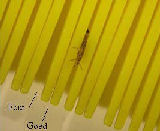
- stand between 0.2 en 0.3 mm apart
- are angular-shaped, which means diamond-shaped of rectangular, to make lice stick between the teeth
- are strong and a bit flexible
| LICE | infestation | have them? | treatment | success? | prevent | the COMB |
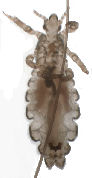
| After day..... | Egg | Nymph | Nymph grows | Adult louse | Egg laying louse | Lous dies |
|---|---|---|---|---|---|---|
| 1 | Egg | |||||
| 7,8 | Nymph | |||||
| 9 | Nymph | grows | ||||
| 10 | Nymph | grows | ||||
| 11, 12 | grows | |||||
| 13 | grows | adult | ||||
| 14-18 | grows | adult | Egg | |||
| 19-22 | adult | Egg | ||||
| 23 | Egg | |||||
| 24-30 | † |
| lice | INFESTATION | have them? | treatment | success? | prevent | the COMB |
| lice | infestation | have them? | treatment | success? | prevent | the COMB |
| lice | infestation | have them? | TREATMENT | success? | voorkomen | the COMB |
|
(quote:)
“de natte haren worden gekamd met luizenkam (… .) met een (gewone) crème spoeling erin. Dit is een onmisbaar onderdeel van de behandeling. Dit moet men dagelijks doen tot veertien dagen na de start van de behandeling. (…) minstens dertig slagen nodig, dat kost al gauw meer dan twintig minuten” (einde quote). Translation: (quote:) Wet hair is combed with a louse-comb(…) with an ordinary cream rinse in it. This is a obligatory part of the treatment. You will have to perform this up till fourteen days after the start of the treatment. (…) at least thirty strokes are necessary, which takes at least twenty minutes (end quote) |
| Brand | Active substance | Min. soaking | Treat again | Instructions anno |
|---|---|---|---|---|
| Para-Speciaal® (Spray) | The pyrethroïds: bioallethrin and piperonylbutoxid |
30 min. | After 8-9 days | 14-3-2001 |
| Loxazol®(Cream Rinse) | Permethrin | 10 min. | 9 2 2006 | |
| Noury® | Malathion | 12 hours | After one week, unless no nits and lice | 9-9-2004 |
| Priodermv (Shampoo) | Malathion | 2x 5 min. | After one week, unless no nits and lice | 9-12-2005 |
| Prioderm®(Lotion) | Malathion | 12 hours | After one week, unless no nits and lice | 19-01-2006 |
| Brand | Auxiliary substances |
|---|---|
| Para-Speciaal® (Spray) | Butane, Petroleum oil |
| Loxazol®(Cream Rinse) | stearalkoniumchlorid, cetylalcohol, polyoxyethylene 10 cetylether, hydroxyethylcellulose, hydrolysed proteins, methylhydoxybenzoate, isopropanole 200 mg, Canada balsem, perfume, propylhydroxybenzoate, propyleenglycol, citrate, Sunset yellow (E110) |
| Noury® | ethanol |
| Prioderm® (Shampoo) | Cetostearyl alcohol, lauryldiethanolamid, etoxyled lanolin, methyl-hydroxybenzoate, propyl-hydroxybenzoate, sodiumlaurylsulfate, hydrochloric acid, disodiumfosfate, citrate, disodiummedetate (E110) and perfume |
| Prioderm® (Lotion) | Terpineole, perfume and isopropyl alcohol |
| lice | infestation | have them? | treatment | success? | SUCCESS? | prevent | the COMB |
| lice | infestation | have them? | treatment | success? | PREVENT | the COMB |
| lice | infestation | have them? | treatment | success? | prevent | THE COMB |
|
|
| The lice-comb is a plastic comb with on both sides short closely spaced teeth. With this one you can’t remove nits. | |
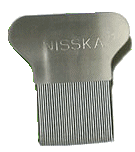 |
The Nisska-comb is advised by the RIVM and is a steel comb with long more closely spaced teeth. With this one you can remove nits. The nits are striped from the hair or squashed (). |
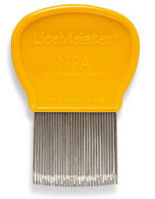 |
The LiceMeister Comb. has long taper teeth that slides easy through the hair. (). This comb was developed by the National Pediculosis Association (NPA). This non-commercial American organisation promotes fighting lice without using chemical pesticides. She also informs about methods to control and get rid of lice and is doing research. Look at their very informative site: http://www.headlice.org . |
| The elektric lous comb should find and destroy lice by a light electrical shock. Despite the nice story, not everybody is as much delighted. If you understand Dutch read this: http://www.kidstoday.nl/wbs/projecten/News_CategoryView.aspx?id=%2Fwbs%2FProjecten%2F28%2F. |



Last update: May 6, 2008
Disclaimer en ©Copyright Stichting Adamanthea